
This week, I had the opportunity to partner with a classmate, Chris Blake. Chris is a Game Developer and an adjunct professor at Quinnipiac University. We sat down for 90 minutes to go through A Virtual Crash Course in Design Thinking, by Stanford University’s Hasso Plattner Institute of Design, also known as the d.school. This crash course “lets you experience one of the d.school’s most popular learning tools.”
The course walked us through a collaborative project called the “Gift-Giving Cycle.” The project consists of multiple sections that walk students through the basic principles of design thinking.
DESIGN THINKING: a methodology for creative problem-solving.
My Thoughts of the Course
Overall, I enjoyed the Design Thinking Crash Course. At first, the course was somewhat intimidating. However, as Chris and I worked through each section, my interest and curiosity grew. Although I attended a class alongside Chris last semester, I learned more about him, his life, his loved ones, and who he is as a person through this 90-minute crash course. I also gained more understanding of the design thinking process during this time.
My Perception of Design Thinking
Before taking the course, I had an unclear understanding of the five stages of design thinking. Furthermore, I was confused about design thinking altogether, as it seemed like everyone had their own design thinking definition and process. After taking the course and walking through the stages, I can differentiate between each of the stages distinctly. I also have a deeper understanding of the non-linear and iterative qualities of design thinking.

Surprising Aspects
The course surprised me most in two ways. First, I did not think that a problem statement could be identified and defined in just four steps. Chris informed me that he gave his brother a bread-baking book for Christmas. When I dug deep, he explained that his brother was a recent divorcee, and this would have been his first Christmas alone. Further discussion revealed that Chris wanted to cheer his brother up, and he cared about his well-being.
From here, my problem statement surfaced: Chris needs a way to encourage other people because he understands that others need support while experiencing difficult life challenges. Voila! Just like that, I was able to identify Chris’s needs.

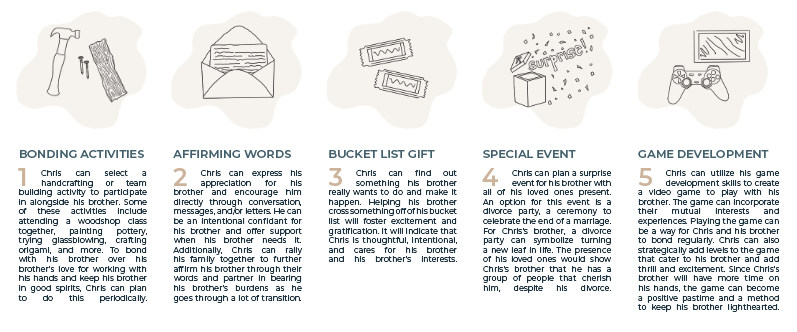
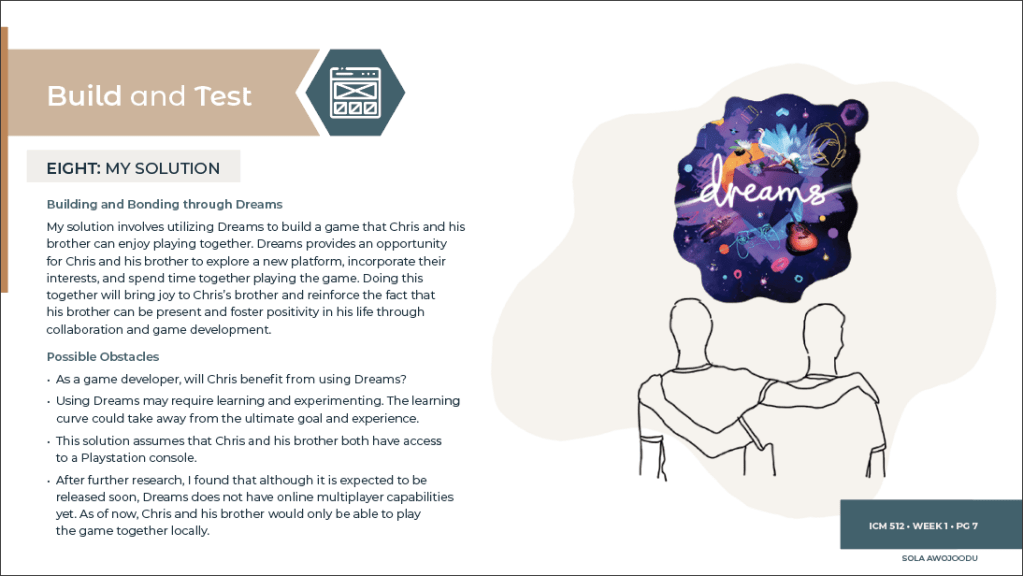
My second surprise came about while ideating. I felt like my ideas were rushed, basic, and likely to be scrapped. To my surprise, Chris could identify with a number of my solutions. He narrowed it down to one solution that I developed further and finalized.

Challenging Aspects
One of my main challenges was the 90-minute timeframe. I initially thought 90 minutes was a long time to work through the course. However, as I progressed, I felt rushed. I felt I needed more time to spark my creativity and innovation. I also struggled with the quantity over quality approach to the ideation stage because I wanted my solutions to be concrete. In hindsight, I understand the purpose of the way the course is formatted. It gave me a good glimpse into the design thinking process as a whole.
What I Would do Differently
If I were to do the course over, I would likely create a physical prototype. My final solution was more of an experience, not a physical item. While prototyping, I felt limited. I took to creating a visual representation digitally. I now understand that prototyping also requires thinking out of the box. Moving forward, I would like to improvise better and find a way to represent the experience effectively. This could mean using play-doh or legos to model the experience.

Final Thoughts
If you would like to explore a new approach to creative thinking and problem solving, grab a friend and check out Stanford’s Design Thinking Crash Course. This course will challenge you to address your problems head-on, push you to utilize your imagination, motivate you to find a workable solution, and encourage you to step out of your comfort zone.

 Sola's Thoughts