How Products and Services Evoke my Emotions


What’s your favorite device? What service have you been raving about to all your friends and family? Is there a product you used recently that frustrated you? Why?

According to Don Norman, an American researcher, professor, author, and the Grand old man of user experience design, emotional engagement is a key factor to consider when designing a product or service because people are emotional. Emotions are powerful. How we feel about a product or service determines how we value it.


“Everything has a personality: everything sends an emotional signal. Even where this was not the intention of the designer, the people who view the website infer personalities and experience emotions.”

Don Norman, Grand Old Man of User Experience

This week, I took a look at a selection of my everyday products, devices, and services to assess the way they make me feel. I analyzed my emotional response to three things using the following phrase:

________ makes me FEEL _________ because my NEED for __________ is OR is not being met.

(In this case, my needs are met.) Here is why I value herbal tea, Amazon Prime, and my Vivint Video Doorbell Camera.


Product: Herbal Tea

Herbal tea makes me feel relaxed because my needs for resthydration, and immune support are being met. 

I drink herbal tea regularly, especially during colder seasons, because it gives me extra warmth and comfort. Drinking tea is calming and provides a way to prepare for the day or unwind at night. Healthwise, tea is an additional way to stay hydrated and support my immune system. There are quick tea remedies for various ailments, including a sore throat, common cold, and stomach ache, and, for me, they work! Last week’s stomach ache dissolved, thanks to Traditional Medicinal’s Belly Comfort Tea.

Service: Amazon Prime

Amazon Prime makes me feel satisfied because my needs for accessibility and efficiency are being met. 

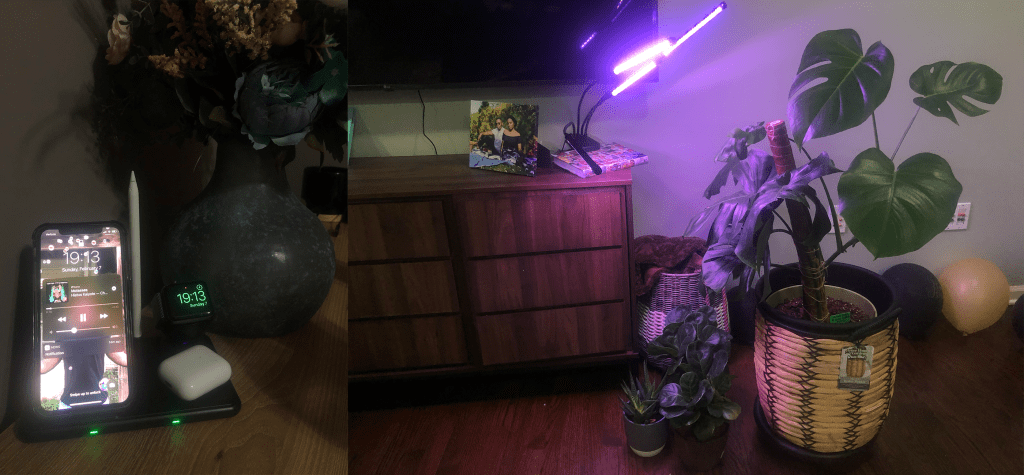
You may already be familiar with Amazon Prime’s same-day, overnight, one-day, or two-day delivery. I benefit from Amazon’s speedy delivery consistently. Although I occasionally return products, I am generally satisfied with the variety of products and prices Amazon offers and how quickly my orders arrive. Shopping on Amazon is much easier than visiting numerous stores to compare products and prices, especially during a pandemic, in which some items may not be as accessible. I also appreciate the detailed reviews that customers write, allowing me to make more informed decisions when purchasing an item. So what are my most recent Amazon buys? A grow light for my houseplants (since it’s winter and there’s not as much daylight) and a 4-in-1 wireless charger to charge my Apple watch, apple pencil, iPhone, and AirPods all in one place. 

Device: Vivint Video Doorbell Camera

Vivint’s Video Doorbell Camera makes me feel conscious and informed because my needs for presence and security are being met.

When someone presses our doorbell, it rings throughout the house. I also get a notification on my phone that says, “someone rang your doorbell.” The doorbell’s camera records live video, alerting my husband and me when someone comes to the door or when a package is left on our doorstep. Using our devices, we can monitor our door front at any time and replay video clips to keep track of activity around our home. Being aware of my surroundings is very important to me, as I am very cautious and concerned with my safety. Our home security system and doorbell camera make me feel more secure and comfortable, especially since I am new to home, neighborhood, county, and surroundings. Here’s a video of my puppy dashing out of the house while I attempt to retrieve a package.


Looking Ahead

So what does this mean for designers? Simply put, emotions affect a user’s views, interactions, and value of a product or service. Therefore, designers should seek to incorporate emotional design in their work by creating “designs that evoke emotions which result in positive user experiences.” Evoking your user’s feelings prompts more engagement with your product/service and more attachment to it. Emotion is a way to connect with your user(s), causing them to create a lasting relationship with your brand. Effective emotional design makes the user’s experience more enjoyable, memorable, and personal. In any form of design, it is important to consider your audience. However, alongside their needs and their desires, their feelings are valid too. 

Redesigning the Gift-Giving Experience: My Take on Stanford’s Design Thinking Crash Course

This week, I had the opportunity to partner with a classmate, Chris Blake. Chris is a Game Developer and an adjunct professor at Quinnipiac University. We sat down for 90 minutes to go through A Virtual Crash Course in Design Thinking, by Stanford University’s Hasso Plattner Institute of Design, also known as the d.school. This crash course “lets you experience one of the d.school’s most popular learning tools.”

The course walked us through a collaborative project called the “Gift-Giving Cycle.” The project consists of multiple sections that walk students through the basic principles of design thinking.


DESIGN THINKING: a methodology for creative problem-solving.


My Thoughts of the Course

Overall, I enjoyed the Design Thinking Crash Course. At first, the course was somewhat intimidating. However, as Chris and I worked through each section, my interest and curiosity grew. Although I attended a class alongside Chris last semester, I learned more about him, his life, his loved ones, and who he is as a person through this 90-minute crash course. I also gained more understanding of the design thinking process during this time. 


My Perception of Design Thinking

Before taking the course, I had an unclear understanding of the five stages of design thinking. Furthermore, I was confused about design thinking altogether, as it seemed like everyone had their own design thinking definition and process. After taking the course and walking through the stages, I can differentiate between each of the stages distinctly. I also have a deeper understanding of the non-linear and iterative qualities of design thinking.


Surprising Aspects

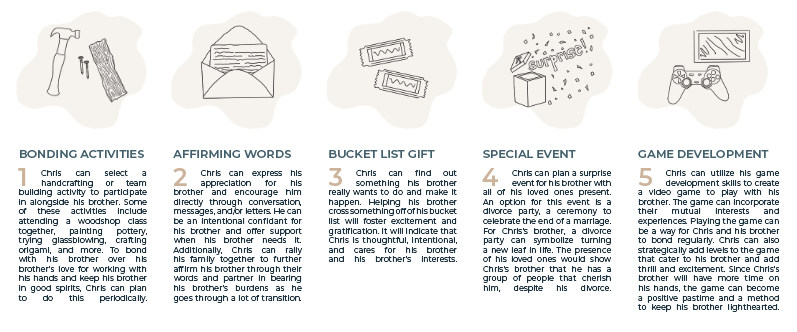
The course surprised me most in two ways. First, I did not think that a problem statement could be identified and defined in just four steps. Chris informed me that he gave his brother a bread-baking book for Christmas. When I dug deep, he explained that his brother was a recent divorcee, and this would have been his first Christmas alone. Further discussion revealed that Chris wanted to cheer his brother up, and he cared about his well-being.

From here, my problem statement surfaced: Chris needs a way to encourage other people because he understands that others need support while experiencing difficult life challenges. Voila! Just like that, I was able to identify Chris’s needs.

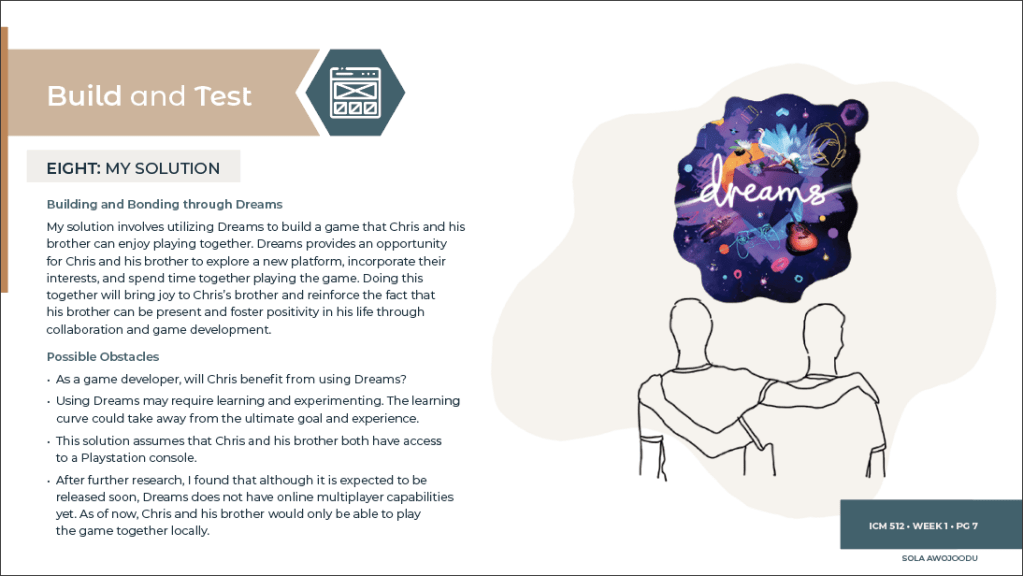
My second surprise came about while ideating. I felt like my ideas were rushed, basic, and likely to be scrapped. To my surprise, Chris could identify with a number of my solutions. He narrowed it down to one solution that I developed further and finalized. 


Challenging Aspects

One of my main challenges was the 90-minute timeframe. I initially thought 90 minutes was a long time to work through the course. However, as I progressed, I felt rushed. I felt I needed more time to spark my creativity and innovation. I also struggled with the quantity over quality approach to the ideation stage because I wanted my solutions to be concrete. In hindsight, I understand the purpose of the way the course is formatted. It gave me a good glimpse into the design thinking process as a whole.


What I Would do Differently

If I were to do the course over, I would likely create a physical prototype. My final solution was more of an experience, not a physical item. While prototyping, I felt limited. I took to creating a visual representation digitally. I now understand that prototyping also requires thinking out of the box. Moving forward, I would like to improvise better and find a way to represent the experience effectively. This could mean using play-doh or legos to model the experience. 

Play-Doh Prototyping Example from “Prototyping with Play-Doh,” Sheryl James

Final Thoughts

If you would like to explore a new approach to creative thinking and problem solving, grab a friend and check out Stanford’s Design Thinking Crash Course. This course will challenge you to address your problems head-on, push you to utilize your imagination, motivate you to find a workable solution, and encourage you to step out of your comfort zone.

Stanford Design Thinking Virtual Crash Course

The Relevance of Design Thinking

What’s your go-to method of problem-solving? Have you tried design thinking? 

InVision defines design thinking as “a process that seeks to solve complex problems by approaching it from the user’s perspective.” This process is useful in solving problems identified across varied platforms, fields, professions, industries, countries, and beyond.


“Design thinking is a human-centered approach to innovation that draws from the designer’s toolkit to integrate the needs of people, the possibilities of technology, and the requirements for business success.”

Tim Brown, Executive Chair of IDEO

Design Thinking in a Nutshell

The design thinking process has one key point of focus: the user. It identifies the needs of the user and seeks to meet these needs. “Design thinking is both an ideology and a process that seeks to solve complex problems in a user-centric way. It focuses on achieving practical results and solutions,” writes Emily Stevens from InVision. Through five stages, design thinking yields creative and innovative solutions to complex problems.


Design Thinking Stages

Design thinking is encapsulated by five actionable stages: Empathize, Define, Ideate, Prototype, and Test.

The 5 Stages of Design Thinking by InVision
  • Empathize: This stage seeks to understand your target audience and the problem(s) they face. This is accomplished through immersing yourself in the environment of your audience. Ask questions, take surveys, seek experiences, and dig deep.
  • Define: After gaining insight into your user’s perspective, you can use what you learned to define the problem. In this stage, the goal is to formulate a problem statement. The problem statement focuses on the user’s core needs. It is a guiding point for all subsequent stages. You can view it as a mission or vision statement.
  • Ideate: The third stage involves generating ideas. This is where you brainstorm ways to address your user’s needs. Viewing your problem in alternative ways and thinking outside the box is encouraged. In this stage, it is more important to come up with multiple feasible ideas. Quantity wins over quality here. 
  • Prototype: Prototyping involves selecting the best of your ideas and creating an inexpensive version of your solution(s). This experimental stage is a chance to create something tangible. Prototypes are often created using whatever materials may be available, including paper, tape, paper clips, play-doh, popsicle sticks, etc. The product is a simple first draft of your main idea. 
  • Test: In the testing stage, your user will interact with your prototype and provide feedback. This stage helps you determine whether your solution is valid or if it needs reworking. Although this is the final stage, your results may lead you back to prior stages, or even as far back as identifying additional needs and redefining the problem.

Design Thinking Benefits

So why is design thinking relevant? Here are some benefits of design thinking.

  • Design thinking helps you gain a deeper understanding of others. It is not focused on a vague problem or hypothetical scenario. Design thinking addresses the needs of real users with valid experiences. It calls you out of your comfort zone into the reality of other people. Instead of judging a situation and making assumptions, design thinking challenges you to ask questions, observe experiences, assess perspectives, gain insight, and think deeply. 
  • Design thinking encourages everyone to wear their creative hat. Anyone can be a design thinker. According to IDEO, design thinking “allows people who aren’t trained as designers to use creative tools to address a vast range of challenges.” Furthermore, Fast Company writes, “There are no judgments in design thinking. This eliminates the fear of failure and encourages maximum input and participation. Wild ideas are welcome, since these often lead to the most creative solutions. Everyone is a designer, and design thinking is a way to apply design methodologies to any of life’s situations.”
  • Design thinking promotes thinking outside the box. It encourages addressing a problem from various angles. Despite the challenges, design thinking enables optimism regarding the solution. It is an iterative, flexible, and non-linear process. Therefore, it promotes creative thinking, highlights endless possibilities, and generates new ideas. It pushes beyond limits and outside borders. Clint Runge explains that, instead of thinking outside of the box, he thinks “on its corner, its flap, and under its barcode.” 
  • Design thinking produces real results. Stevens suggests that design thinking focuses on achieving practical results and solutions that are technically feasible, economically viable, and desirable for the user.
Kaiser Permanente and Design Thinking

Here’s a real-world example. In 2003, IDEO collaborated with Kaiser Permanente to implement design thinking in hopes of enhancing Kaiser’s patient and employee experiences. “Close observation of actual shift changes, combined with brainstorming and rapid prototyping, produced new procedures and software that radically streamlined information exchange between shifts. The result was more time for nursing, better-informed patient care, and a happier nursing staff” (Harvard Business Review, June 2008).

As a patient with a chronic illness, I can attest to these results first hand. Growing up with Sickle Cell Disease, I experienced multiple pain crises every year. Some of these crises could be managed at home, but severe crises would send me straight to urgent care or the emergency room. In my adolescent years, I became very familiar with Kaiser Permanente, as I was covered under their insurance. To this day, I can say that Kaiser provided some of the best care I have experienced and addressed my pain exceptionally well. Much of this can be attributed to Kaiser’s nurses and employees. Unlike other emergency healthcare services I have encountered, with Kaiser, I rarely waited to be treated, my pain medication schedule was maintained, my crises were assessed accordingly, beds were prepared for me in hospitals ahead of time so that I could skip the emergency department, and I was included in my treatment plan. This can all be attributed to Kaiser’s intentional innovation and design thinking. 


Final Thoughts

In conclusion, there are many other benefits of design thinking, but I will wrap up with this – design thinking is relevant. Next time you run into a complex problem whether at work, in school, at home, in your county, state, or country, consider taking the design-thinking approach.